Sayfalar

istatistik etiketine sahip kayıtlar gösteriliyor. Tüm kayıtları göster

13 Haziran 2019 Perşembe

Son 70 yılın PubMed makale konuları

Buna benzer bir çalışmayı patoloji makalelerinde yapmış, USCAP'te sunmuştuk.

Şimdi yeniden veritabanını kurup bu grafiğe benzer bir grafiği de hazırlamak istiyorum.

R'da ve app ile nasıl yapılacağına dair bir örnekler buldum:


https://www.youtube.com/watch?v=6z9_fjCuQtE
This is how diseases were studied in the past 70 years.
We have analyzed over 29,000,000 articles and 250GB of data.
Computational Systems Biology Laboratory (csbiology.com).

20 Aralık 2018 Perşembe

eşek tepmesinin otopsi bulguları

Poisson dağılımının atların tekmelediği insan sayısının dağılımını açıklamak için kullandıklarını okumuştum:

In 1898, Russian economist Ladislaus Bortkiewicz published his first statistics book entitled Das Gesetz der keinem Zahlen, in which he included an example that eventually became famous for illustrating the Poisson distribution.

Hayvanların sağlık istatistiklerindeki yeri o kadar önemli görülmüş olacak ki ICD kodları içine de eklenmiş:

HOLY COW! NEW (AND UNUSUAL) ICD-10 CODES


Geçenlerde okuduğum makale ise eşek tepmesinin otopsi bulguları ile ilgili.


Autopsy Features of Fatal Donkey Attack
Am J Forensic Med Pathol. 2018 Dec;39(4):354-356.
doi: 10.1097/PAF.0000000000000406.

Bunu paylaştığım bir Hoca'mız ise makalenin başlığını şöyle çevirdi:


Eşşek depmesiynen husûle gelen mevtin şerhi içün amel olunan feth-i meyyit neticesinde...

23 Eylül 2018 Pazar

JASP ile tek örnek T testi

How to Conduct a Classical One-Sample T-Test in JASP and Interpret the Results - JASP - Free and User-Friendly Statistical Software: The one-sample t-test is used to answer the question of whether a population mean is the same as a specified number, also called the test value. This blog post shows how to perf-orm the classical version of the one-sample t-test… Continue reading →


30 Haziran 2018 Cumartesi

Otomatik olarak R ile günlük analiz yapıp git ile güncelleyin

Bu kodları çok farklı sayıda blog ve yazıdan derledim :)

Hedefim şu. Elimde bir R Markdown ya da R Notebook dökümanı var. Bunu belirli periyotlarla çalıştırıp güncel analizi git komutları ile github sayfama yüklemek istiyorum.

Böylece belirli bir API'den çektiğim veriyi belirli periyotlarla analiz edebileceğim.
Bu şekilde PubMed verisi üzerinde güncel analizlerimi oluşturmaya başladım.

Örnek otomatik analizler:
https://sbalci.github.io/pubmed/SchedulePubMedAnalysis.nb.html 

Örnek PubMed analizleri:
https://sbalci.github.io/ResearchOnBibliography/

1) R-project kodunu belirli periyotlarla çalıştırmak için RStudio'nun eklentilerini kullanıyorum:


Böylece aşağıdaki R dosyasını otomatik olarak belirli periyotlarla çalıştırmak mümkün.

2) Otomatik çalışan bu R kodunu kullanarak analizimi içeren R Markdown dosyasını çalıştırıp html çıktısını oluşturuyorum:

library(rmarkdown)
library(pander)
rmarkdown::render(input = "ScheduledAnalysis.Rmd",
output_format = "html_notebook",
output_file = "docs/ScheduledAnalysis.html",
quiet = TRUE)


3) Aynı R kodu içinde rstudioapi paketi ile de comand line, bash, terminal komutlarını da otomatik olarak çalıştırmak mümkün. Böylece git push da aynı anda yapılabiliyor.

library(rstudioapi)
CommitMessage <- paste("updated on ", Sys.time(), sep = "")
gitCommand <- paste("git add . \n git commit --message '",
CommitMessage,
"' \n git push origin master \n", sep = "")
gitTerm <- rstudioapi::terminalCreate(show = FALSE)
rstudioapi::terminalSend(gitTerm, gitCommand)


23 Haziran 2018 Cumartesi

ICD-O sınıflama sisteminin Türkiye'de kanser kayıt sistemi için kullanılması

ICD-O sınıflama sisteminin Türkiye'de kanser kayıt sistemi için kullanılması yönünde uzun süredir devam eden çalışmalar var.
Aşağıda bu konuyla ilgili olarak ResearchGate'de (https://www.researchgate.net/profile/M_Serefettin_Canda2) yapılmış yazışmaları ve bu konu ile ilgili yayını Dr.Canda'nın (https://www.facebook.com/profile.php?id=585619267) da izni ile paylaşıyorum.
 
Ben uzun süredir pratikte çalışmadığım için güncel durumdan habersizim, sadece bibliyografik çalışma hobim (https://www.serdarbalci.com/p/bibliographic-studies.html) nedeniyle bu konu ile ilgilenmeye devam ediyorum. Kanser istatistiklerinin düzenli tutulması, büyük bölge hastanelerinden yıllık kongrelerde düzenli güncel sayıların sunulması ve trendlerin incelenmesinin önemine hep inandım.
 
Özellikle büyük bölge hastanelerinde çalışan patologların bu konu ile ilgili öneri, katkı ve eleştirilerini Dr.Canda'ya ya da federasyona iletmesi bu konudaki çalışmalara destek olacaktır.
 
 
-
Dear Serdar Balcı,
I would like to know to your views on the following topics.
- "ICD-O 3.1 Turkish version"
- "New Histopathological Diagnostic Terms and their Codes of the Central Nervous System (CNS) in the International Classification of Diseases for Oncology (ICD-O 3.1)"
-The importance of the coding of the pathology reports according to ICD-O 3.1 for Turkey which is I'm working since 1991 up to now.
With my best wishes.
-
Dear Prof Canda,
Sayın Hocam,
Thank you for sharing your work on ICD codes with me. I would like to thank and congratulate you on this effort.
I am happy for this opportunity to share my ideas on this topic with you.
I have experience in SEER data and have actively participated in gathering and analyzing SEER data during my research days in Atlanta, in Emory Epidemiology Department with Dr.M.Goodman. I have also published articles using these community data. I always have dreamed to have a similar database in Turkey as well. I have not been in practice for a while, so I am not aware of the current situation. But as I used to be responsible for the pathology information system and quality control, I have experienced many problems in cancer registry process.
First and foremost, the registry is now defined as a duty for pathologists, unlike to those of other countries where registry is performed by other professionals namely "registrars". Considering the amount of workload on a practicing pathologists, this is becoming as a burden, as I believe that the codes are not easy to apply in routine practice.
Pathologists are used to diagnose with histologic codes and WHO blue books. It would be more easy for pathologists, if they are asked to name which WHO blue book they used and which histology code they gave. Any pathology information system can be adapted very easily for this. The data retrieved as histologic code and major organ/system can then easily be converted to ICD codes via computers.
I do not think that details of location (whether the kidney tumor is on right or left kidney) is not required. But the selection of kidney and appropriate "papillary carcinoma" is important. I have faced many "papillary carcinoma" or "in situ ductal carcinoma" codes mistaken among various organs, as well as "basal cell carcinoma" mistaken for other basaloid neoplasms.
In my research on SEER data of gallbladder and pancreas tumors, I found that tumors are inappropriately coded histologically. Even major subtypes are not easy to identify, not to mention confusing benign and malignancy terms. Since pathologists are now the official registrars here, at least we may have an opportunity not to make the same mistake SEER has made decades ago.
If we use histologic codes primarily than it will be much easy to see trends in diagnosis and treatments as well as it will be easy to track when the nomenclature changes, which is the hobby of pathologists :)
I would like to thank you again for asking my opinions on this topic.
Best regards.
Serdar Balcı, MD, Pathologist
-
Many thanks for your detailed and informative response.
-All Turkish pathologist must contribute to and do ICD-O work in the world in the scientific field.
-In terms of ICD-O's implementation, what should we do about it in Turkey.
My purpose is as follows:
a) The ICD-O system has been used worldwide since 1976.
b) Turkey has also decided to implement since 2015.
c) For Turkey, this is a very important development.
d) It is important that "ICD-O 3.1 Turkish version, 2017" is implemented in a healthy manner.
e) What should be done for this purpose?
f) What are the views of the pathologist?
g) I believe in the benefit of being a "solution-oriented debate".
Conclusions and recommendations;
1. I have been working since 1991 to use the ICD-O coding system.
2. Cooperation of the Ministry of Health and Universities is very importend.
3. Persons who believe in the importance of this matter and have knowledge should be taken into consideration.
4. For the computer coded program, the opinion of pathologists must be taken.
5. Those who have worked outside the Ministry of Health and NGO representatives should also be considered.
6. Conclusion: Loading "additional workload" into pathology specialists does not solve the problem.
7. The work should be solution focused.
8. The coded program should be open to criticism from pathologists.
9. What are the opinions of Pathologists?
Greetings, best regards
-
Dear Prof Canda,
With your permission I would like to copy our conversation to facebook groups and other social media, in order to have more opinions from Turkish pathologist.
Please let me know if I can copy this conversation and ask friends opinion.
Best wishes
Serdar
-
Good morning, Greetings and good days.
Thank you for your suggestion. I hope that better ideas emerge.
(-Due to the "performance system" in hospitals, the times and "pensions" of especially idealistic Doctors are very limited.)
-My objective is also the coding of Tumor Pathology Reports according to "ICD-O 3.1 Turkish version, Ministry of Health of Turkey, 2018, Ankara".
-To encode the Tumor Pathology Reports, it is necessary to make an effort (+) together (Ministry of Health and Universities-Pathologists, Cancer Registrers and Computer Programmers).
-I have been working on this subject since the year of -1991.
-Yet, it was not widespread use of computers in Turkey in that period.
-In my assistantship years, there were some studies in the Department of Pathology of Ege University Faculty of Medicine (1972-1975).
Prof. Dr. Yavuz Aksu was working on the Index-Card system.
My Professour Yavuz Aksu made an effort to do "Index Card system" and he indicates the importance for scientific studies and for Turkey.
-I also tried to collect regional cancer cases in the Ataturk University, Cumhuriyet University and Dokuz Eylül University in the following years and published in a part of it.
-I published some of the my studies at Ataturk University in the Ankara Bulletin of Pathology (Editor Prof. Dr. Muharrem Köksal, 1976,1977).
-Nowadays computer programming systems and digital revolution are very important developments.
Therefore;
If we do that;
-without being too late
- as "open" minded scientists,
- working with a focus on "solving contribution"
-Turkey can also take place among the Countries that effectively implement ICD-O in the world.
Furthermore, the fact that "ICD-O Turkish version"
-It also allows Turkish to become one of the most spoken languages ​​in the world.
-If it was an alphabetical unity, other Turkish-speaking countries could have been involved in this system.
In Turkey
-cancer map and regional cancer studies
- in terms of frequency of cancer and public health problems,
- in terms of making things healthy in this area and
- It allows the Turkish doctors and Turkish cancer patients to use the same language "at the same time" with the world.
- Turkey will be get much more healthy cancer statistics
- Turkey and the Turkish scientists of international reputation increases.
I offer my respects to all colleagues who will contribute to this issue.
Greetings, sincerely yours
Prof. Dr. M. Şerefettin Canda
June 22, 2018, Güzelbahçe-İzmir


İlk paylaşım linki

6 Mayıs 2018 Pazar

StackOverFlow kitap haline dönüşürse

StackOverFlow'da yazılan yazıların derlemesi ile kitaplar oluşturulmuş:

Programming Notes for Professionals books
https://goalkicker.com/

Kitaplar yeni gönderilerle güncelleniyormuş.

Ben R için olan kitaba hızlıca baktım:
https://goalkicker.com/RBook/

Bence dizayn ve içerik olarak gayet güzel olmuş.


1 Mayıs 2018 Salı

Biraz SPSS, biraz Excel, biraz R : BlueSky Statistics

İstatistik için ücretsiz bir program arıyor, biraz SPSS'e benzesin, biraz Excel, biraz da R olsun diyorsanız BlueSky Statistics'i bir denemenizi öneririm:

http://www.blueskystatistics.com/


  • Overview of BlueSky Statistics


  • Getting Started with BlueSky Statistics


  • Model fitting and scoring with BlueSky Statistics


  • KNN with BlueSky Statistics


  • Market Basket Analysis and Associate rules with BlueSky Statistics


  • Using dialog editor to create dialogs and richly formatted output with BlueSky Statistics


  • Creating more sophisticated dialogs with dialog editor


  • Creating a dialog for a data manipulation command with BlueSky Statistics


  • Creating a dialog for a graphics command with BlueSky Statistics


30 Nisan 2018 Pazartesi

RCode, yeni bir R arayüzü

R için yeni bir arayüz (GUI) olan RCode denemeye başladım: https://www.pgm-solutions.com/rcode


Bu arayüzün en dikkat çekici tarafı veriyi arayüz içinde düzenleyebilmek.

Grafik fonksiyonlarını henüz denemedim.


23 Mart 2018 Cuma

SPSS de kendini geliştiriyor

Çok fazla üstüne gidiyoruz, tüm dünyada giderek daha az kullanılıyor ama SPSS de kendini geliştiriyor.

Demo of SPSS Statistics Preview

21 Mart 2018 Çarşamba

Jamovi ile SPSS dökümanları açılabiliyor

Jamovi ile artık SPSS, SAS ve Stata dökümanları açılabiliyor.

Dosya menüsünden Open altında;


ilgili veri türünü seçmek mümkün. Gerçi Data Files kısmında bırakınca da belgeleri görüyor


SPSS'in .sav dosyaları açılabiliyor.


Kodlanmış verilerdeki değerler de Jamovi içinde korunuyor.


Yavaş yavaş ücretli programlara olan bağımlılığımızdan kurtulacağız :)


18 Mart 2018 Pazar

SPSS'ten R'a geçerken

SPSS yerine R kullanmaya başlayanlar için öğrenme eğrisini geçerken yardımcı olabilecek bazı kurs ve paketler var:
SPSStoR paketi spss syntax dosyasını R koduna dönüştürüyor. Oluşan kod birebir değil, üzerinde çalışmak gerekiyor ama yine de ilk başlayanlar için epey bir fikir veriyor.
R package to convert SPSS syntax to R code https://github.com/lebebr01/SPSStoR

SPSS syntax oluşturmak için şu sayfada anlatılanları yapabilirsiniz:  SPSS Syntax Beginners Tutorial

Bu kurs da faydalı olabilir:  R for SAS, SPSS and STATA Users

12 Mart 2018 Pazartesi

R-project, kolay analizler için zor, zor analizler için kolay

R kullanmanın zor yanlarından daha önce bahsetmiştim.

"R: simple for complex tasks, complex for simple tasks" adlı yazı hislerime tercüman olmuş. Gerçekten de basit şeyleri yapabilmek için epey bir emek gerektiriyor.

Ama aynı verinin sürekli güncellenerek geldiği durumlarda, kodla çalışmak gerçekten çok iyi oluyor. Maalesef sütunların yerini değiştirip, yeni sütunlar eklendiğinde JASP ve Jamovi beklenen performansı veremiyor ve bazen çöküyor. Jamovi ve JASP'ın syntax dosyasını ayrıca vermemesi de tekrarlanabilirliği zorlaştırıyor.

En iyisi R'ı doğru dürüst öğrenmek.


R: simple for complex tasks, complex for simple tasks
https://ekonometrics.blogspot.com.tr/2018/03/r-simple-for-complex-tasks-complex-for.html
https://www.r-bloggers.com/r-simple-for-complex-tasks-complex-for-simple-tasks

4 Mart 2018 Pazar

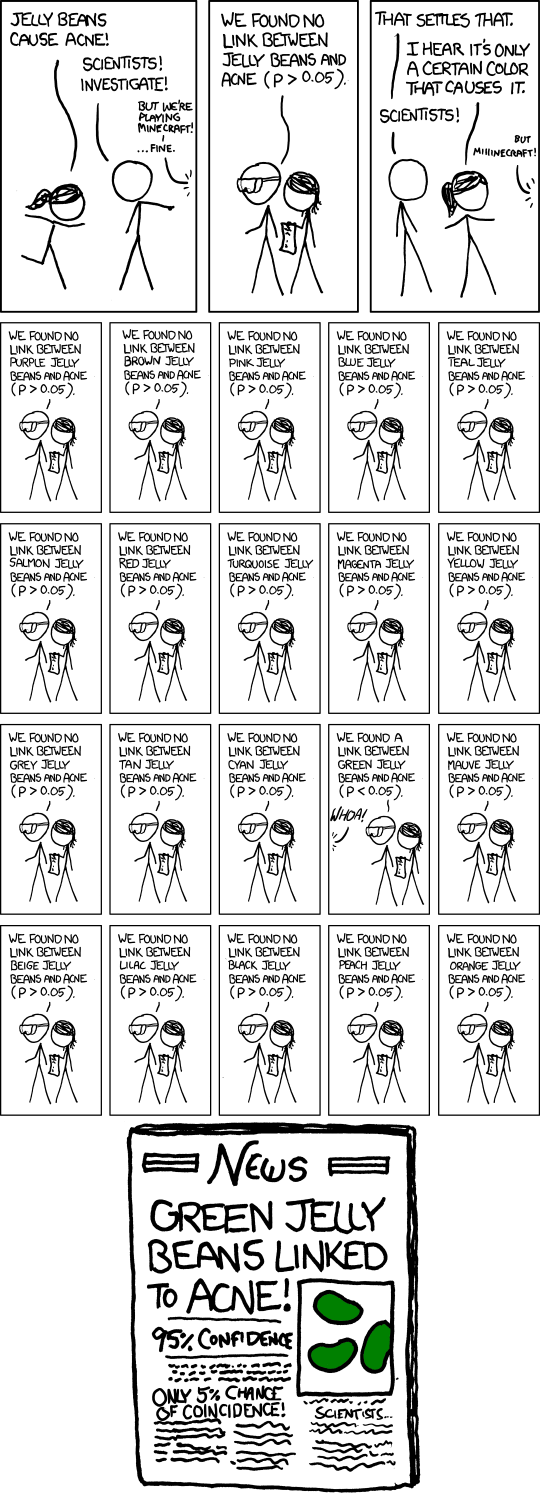
p değeri üzerine bir klasik

p değeri üzerine yüklediğimiz olağanüstü anlamı ve araştırmalarda yapılan en büyük hatalardan birini gösteren bir klasik karikatür, xkcd'den:


19 Şubat 2018 Pazartesi

R-project veri yüklemek neden zor?

Tüm dünya R ile istatistik analizine ilerleyedursun, biz hala SPSS adı altında kurslar düzenleme derdindeyiz. Jamovi gibi grafik arayüzleri varken hem de. Peki neden? Haklı tarafı yok mu?

R savunucuları, bu durumla dalga geçedursun, aslında hala daha SPSS'in kullanılmasının önemli bir nedeni var: veri yüklemek

R'a veri yüklemek neden bu kadar zor. Çoğu data üstadının burun kıvırdığı excel hala daha en çok kullanılan veri giriş modeli. Bir spreadsheet herkesin anlayabileceği kolaylıkta.
Neden hala R'a excel yüklemek bu kadar sorun? En fonksiyonel bulduğum xlsx paketini eklemek için java yüklemek gerekiyor. SPSS için foreign paketleri, haven paketleri ortada geziyor. Hele bir de .csv dosyaları var ki, eğer Türkçe excel kullanıyorsanız ; ile , arasındaki fark herhalde bu kadar anlamlı olmamıştır. Sayılara verdiğiniz . ya da , ile ondalıklar da epey sıkıntıya neden oluyor.

Jamovi de sadre şifa değil, o da henüz .sav dosyalarını okuyamıyor (Onun için önce JASP ile açıp sonra Jamovi ile bu JASP dosyasını açmak lazım). Eğer .csv dosyanızda sorun varsa veriniz de düzgün yüklenemiyor.

SPSS'in bu kadar yaygın olmasının nedeni belki de sadece bu konuda kullanıcı dostu olmaya devam etmesi.

Ortada yığınla R kursu var, ama hepsi afaki şeylerden bahsediyor. Neymiş efendim atomik vektör tipiymiş, zorlama ile türler nasıl değişirmiş, S dili çok önemliymiş, lattice mi kullaılacakmış, ggplot mu? Adama bir ağız tadı ile veri yükletip frekans tablosu aldıramadıktan sonra R çok iyi bir programmış kime ne?

Bu arada R'a veri yüklemenin -ve tabii bunu data.frame olarak yapmanın- en kolay yolu RStudio ile. Dökümana sağ tıklayıp import dataset dedikten sonrası oldukça anlaşılır:


  • RStudio webinar: Getting your data into R

https://www.rstudio.com/resources/webinars/getting-your-data-into-r/
https://vimeo.com/130548869


12 Şubat 2018 Pazartesi

Jamovi'de Sağkalım Analizi

Jamovi ile artık sağkalım analizi yapmak mümkün.

Bunun için Death Watch eklentisini yüklemek lazım:


Daha sonra menüden sağkalım analizini seçip:


İlgili yerleri doldurmak lazım. Event kısmına sağkalım durumu yazılmalı, event level'da ise ölüm durumu seçilmeli. Time elapsed geçen süreyi gösteriyor. Group seçilirse bu gruplara göre karşılaştırmalı eğriler elde edilebilir.


Verilerin türlerine dikkat etmek lazım. Nominal, ordinal ve sürekli değişkenler uygun şekilde düzenlenmiş olmalıdır.


Sağkalım analizinin tanımlayıcı istatistikleri ve ikili karşılaştırmalar:
Veriler değiştirilmiştir :)


Sağkalım eğrisi istenirse güven aralıklı olarak da çizdirilebiliyor:


Eğer R'da  jmv paketi yüklüyse bu kodu kullanarak da analizi yapmak mümkün: